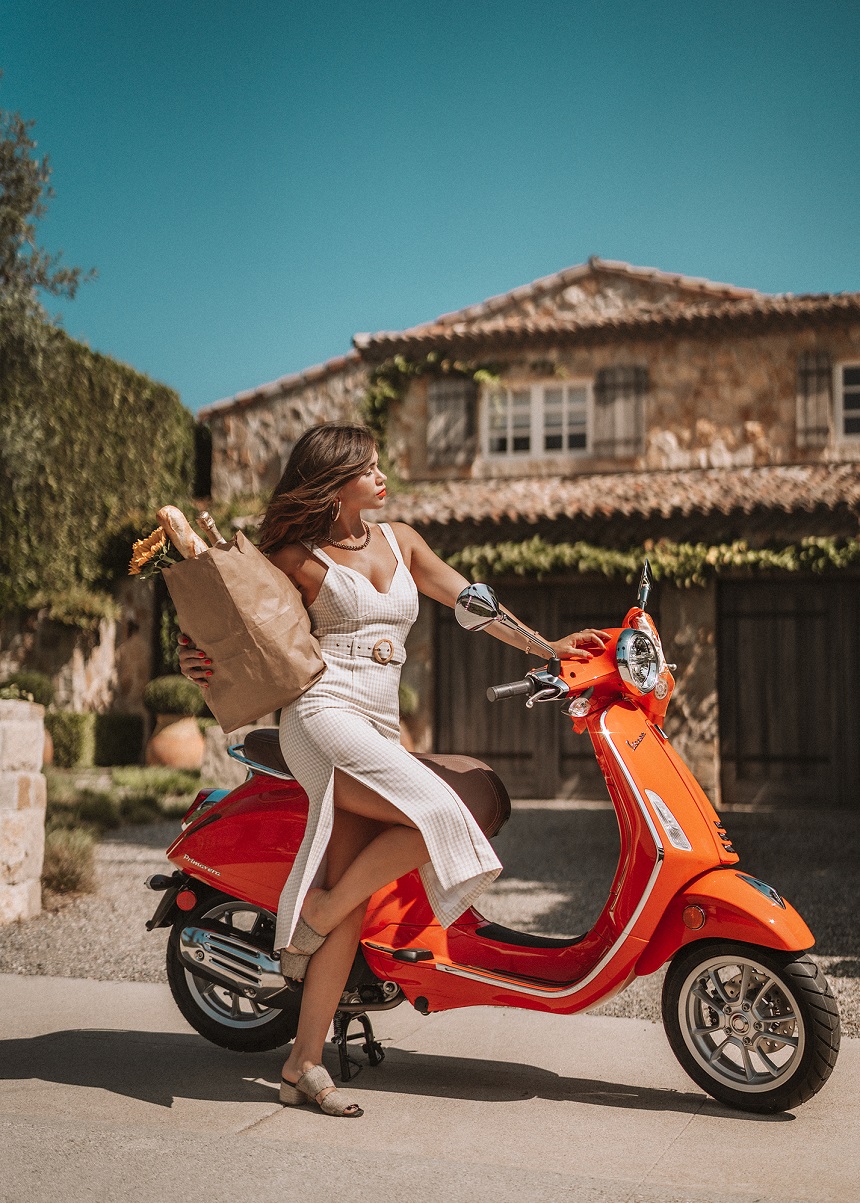
Most people think you need to fly to Cinque Terre to get that shot. Scooter parked on a cobbled slope, pastel buildings stacked behind it, bougainvillea spilling over a white wall. I’ve shot probably 40 Vespa sessions in LA over the last eight years. The secret isn’t finding a fake Italian village. It’s understanding what actually makes those Italian Riviera photos work — the light, the color palette, the texture of the street — and then hunting for those specific elements in LA’s sprawl.
Here’s what I’ve learned. No fluff. Just the spots, the timing, and the mistakes that’ll ruin your shoot.
The Light Window That Makes or Breaks Your Shoot
Italian Riviera light isn’t just bright. It’s warm, directional, and low. You get that between 4:00 PM and sunset, roughly March through October. In LA, that same golden hour hits hard, but the difference is the background contrast.
Why 11 AM shoots fail
Harsh overhead light flattens the pastel colors. Your yellow Vespa looks washed out. The blue sky behind it turns white. I’ve seen photographers show up at noon with a rented mint-green Vespa Primavera ($150/day from RideOn in Venice) and leave with unusable shots. The light is too contrasty — deep black shadows under the scooter, blown-out highlights on the buildings.
The golden hour cheat sheet
April and October give you the longest golden windows — about 90 minutes. July cuts that to 45 minutes because the sun drops almost vertically. If you’re shooting in August, start at 5:30 PM, not 4:00. The light stays harsh until nearly 6:00.
I shoot at f/2.8 to f/4 on a 35mm or 50mm lens to blur background clutter. The Vespa stays sharp; the parking lot behind it disappears. That’s how you fake the narrow streets of Portofino.
One more thing: check the marine layer forecast. June gloom in LA means flat gray sky until 1 PM. Your pastel colors turn muddy. Reschedule.
South Pasadena’s Secret Mediterranean Block
Most people drive straight to the Arts District or Beverly Hills. Wrong move. The best Italianate architecture in LA isn’t in the tourist zones — it’s in South Pasadena, specifically Meridian Avenue between Mission Street and El Centro Street.
This stretch has three things you need: warm ochre and terracotta building facades, decorative ironwork on balconies, and no chain stores. The storefronts are independent. A vintage-looking barbershop. A small bakery with a striped awning. It looks like a side street in Santa Margherita Ligure.
Shoot here at 5:15 PM in May. The sun hits the west-facing facades dead-on. The shadows from the palm trees stripe across the street. Park the Vespa parallel to the curb, angled slightly toward the camera. Don’t center it — frame it with a third of the building behind it.
The catch: this is a residential street. Residents will watch you. Be polite, keep the engine off (Vespas aren’t quiet), and don’t block driveways. I’ve never been asked to leave in eight years. No permit required for a single scooter on public street parking.
Huntington Gardens — The One Location Worth the Permit Fee
I hate paying for locations. But the Huntington Library, Art Museum, and Botanical Gardens in San Marino has a section called the Australian Garden that looks nothing like Australia. It looks like the Ligurian coast. Succulents, olive trees, gravel paths, and a white-columned pergola. The color palette is sage green, dusty blue, and warm limestone.
Here’s the deal: you cannot ride the Vespa inside. You push it. Or you park it and shoot it static. The non-commercial photography permit is $150 for a three-hour window. Commercial shoots (any brand logos visible, or if you’re selling prints) cost $500+. Bring a printed receipt — the front gate checks.
Best spot inside: The Desert Garden Conservatory steps. Terracotta pots, agave plants, a white stucco wall. Put the Vespa at the bottom of the steps, shoot from above at a 45-degree angle. The background compresses into a blur of green and brown. It’s a 10-minute walk from the entrance, so bring a dolly if your scooter is heavy (the 300cc GTS weighs 340 lbs).
The Huntington closes at 5 PM most days. Your shoot window is 1 PM to 4 PM, which is not ideal light. But the architecture and plants do the heavy lifting. Overcast days actually work better here — soft light on the white walls, no harsh shadows.
The Palisades Bluff Overlook — Free, Open, and Undiscovered
I almost didn’t share this one. Palisades Bluff Overlook on the Palisades Park in Santa Monica. It’s a narrow strip of grass and benches on a cliff above the Pacific Coast Highway. The view looks south toward the Santa Monica Pier, but if you turn the camera west and crouch low, the background is just ocean and sky. No buildings. No cars. Just blue.
Why this works for Italian Riviera vibes: The Italian coast is about the relationship between land and sea. A Vespa on a cliff edge, facing the water, with a wide-angle shot — that’s the Amalfi Coast aesthetic without the 12-hour flight.
Practical setup: Park the Vespa on the sidewalk, perpendicular to the cliff wall. The white stucco wall behind it reads as Mediterranean. Shoot with a 24mm lens at f/8 to keep the scooter and the ocean in focus. Use a polarizer to cut glare off the Vespa’s chrome mirrors.
No permit needed. Free parking on Ocean Avenue if you find a spot. Weekday mornings are empty. The light is best at 7:30 AM in summer — the sun comes up over the mountains behind you and lights the scooter, not the ocean. That’s actually better for the Italian look. The water becomes a deep blue backdrop instead of a blown-out white patch.
The Three Mistakes That Scream “This Is LA, Not Italy”
I’ve made all of these. Here’s what ruins the illusion.
- Palm trees in the frame. Palm trees scream Southern California. Italy has umbrella pines and cypresses. If you can’t avoid the palm, shoot from a low angle so the fronds are behind the building roofline, not above it.
- Modern cars in the background. A 2026 Tesla behind your 1960s Vespa kills the period feel. Scout the street beforehand. South Pasadena’s Meridian Avenue has mostly older cars parked. If a Prius shows up, wait 30 seconds — it’ll move.
- American street signs. Green street signs on a pole = dead giveaway. Crop them out or clone-stamp them in post. Or shoot from a height where they’re below the frame line.
One more: don’t use a flash. Italian Riviera light is warm and natural. On-camera flash creates hard, clinical shadows. If you need fill light, use a gold reflector bounced from below — $15 on Amazon, folds flat, fits in a backpack.
| Location | Best Light Window | Permit Needed? | Cost | Vespa Access |
|---|---|---|---|---|
| Meridian Ave, South Pasadena | 4:30 PM – sunset (May-Oct) | No | $0 | Ride on street, park at curb |
| Huntington Gardens | 1 PM – 4 PM (overcast preferred) | Yes (non-commercial) | $150 | Push only |
| Palisades Bluff Overlook | 7:30 AM – 9 AM (summer) | No | $0 | Ride on sidewalk, park on grass edge |
Renting a Vespa That Actually Looks Italian
Not all Vespas are created equal for this shoot. The Vespa Primavera 150 in Bianco Innocenza (white) or Azzurro Mediterraneo (light blue) is the most photogenic. The round headlight, the chrome fender trim, the single rear shock — it’s the silhouette people picture when they think “Italian scooter.”
RideOn in Venice ($150/day) has a fleet of Primaveras in those colors. They deliver to your location for an extra $50. Vespa Sherman Oaks ($175/day) carries the GTS 300 in darker colors — better if you want a more aggressive, modern look, but less classic.
What to check before you leave the rental shop: Tire pressure (low tires make the scooter look saggy in photos), mirror alignment (both mirrors should be symmetrical), and whether the top case is removable. That square black top case ruins the line of the scooter. Ask them to take it off. Most will.
Don’t rent the electric Vespa Elettrica. It looks identical to the Primavera from the front, but the rear has a flat, boxy battery housing under the seat. It photographs poorly from the three-quarter angle. Stick with the gas version.
When to Skip the Vespa Entirely
Here’s the honest take: if your model isn’t comfortable on a scooter, or if you’re shooting in a location with heavy traffic, don’t force the Vespa. The shoot becomes about managing a 300-pound vehicle on a slope instead of taking good photos.
I’ve done shoots where we pushed the Vespa into position, shot for 10 minutes, and then the client wanted it moved 20 feet. That took 5 minutes of awkward shuffling. The energy died. The model’s expression went stiff.
Alternative: Rent a vintage bicycle instead. A blue Schwinn with a wicker basket reads equally Italian, weighs 30 pounds, and you can reposition it in 5 seconds. Or just shoot the model leaning against a wall with no vehicle at all. The architecture and light do the work.
The Italian Riviera isn’t about the scooter. It’s about the feeling of a slow afternoon, warm stone, and the sea within walking distance. If you capture that, you don’t need the Vespa. If you do use it, pick the right spot, the right time, and leave the top case at the shop.